
Choosing the right commercial coffee machine in Singapore is one of the most consequential decisions a food and beverage operator can make, affecting everything from daily beverage quality to long-term profitability. The market offers an extraordinary range of options – from compact bean-to-cup units to full-scale espresso stations – and navigating that range without a clear framework leads to costly mistakes. This guide provides the essential criteria for making a sound investment.
Understanding Your Business Requirements
Before examining any machine, you must first understand the demands of your specific operation. A hotel breakfast buffet serving 200 guests each morning requires fundamentally different coffee brewing equipment than a boutique cafe producing handcrafted drinks for 50 customers a day. The questions that matter most are deceptively simple but critically important.
Volume and Throughput
Calculate your peak-hour demand first, not your daily average. A machine that comfortably produces 80 cups per hour will struggle if your morning rush requires 120. Commercial espresso machines are rated by their boiler capacity, group head count, and recovery time – the speed at which the machine returns to optimal brewing temperature after consecutive extractions.
As a general guide:
- Small offices and boutique cafes: 50 to 100 cups per day – a single-group or bean-to-cup machine suffices
- Medium restaurants and co-working spaces: 100 to 300 cups per day – a two-group machine or high-capacity automatic unit
- Large hotels and high-traffic venues: 300-plus cups per day – multi-group machines or multiple units deployed strategically
Space and Infrastructure
Singapore’s commercial spaces command premium rents, and every square centimetre matters. Measure your available counter space carefully, accounting for clearance above and behind the machine for ventilation and maintenance access. Consider water supply proximity, drainage requirements, and electrical specifications. Many commercial coffee machine models require dedicated water filtration systems and appropriate power outlets.
“Space planning is something many operators overlook until the machine arrives,” says Jonathan Teo, a commercial kitchen design consultant in Singapore. “I always tell my clients to plan the coffee station with the same rigour they apply to their main kitchen layout.”
Types of Commercial Coffee Machines
Traditional Espresso Machines
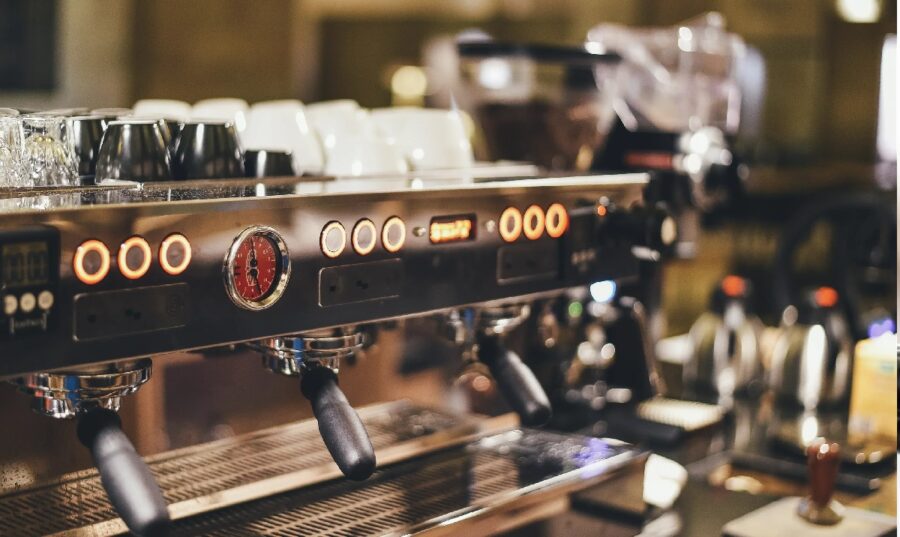
These are the workhorses of dedicated cafes and specialty coffee shops. They offer maximum control over extraction parameters and produce exceptional results in the hands of a trained barista. However, they require skilled operators, regular calibration, and more intensive maintenance than automatic alternatives.
Fully Automatic Bean-to-Cup Machines
These barista machines handle the entire process – grinding, dosing, tamping, extracting, and milk frothing – at the press of a button. They are ideal for environments where staff turnover is high or where dedicated barista training is impractical. Modern automatic machines produce results that rival manual preparation, making them increasingly popular across Singapore’s foodservice sector.
Capsule and Pod Systems
For locations where simplicity and hygiene are paramount – medical facilities, executive boardrooms, and small retail outlets – capsule systems offer convenience with acceptable quality. The trade-off is higher per-cup cost and limited customisation compared to fresh-bean coffee brewing systems.
Key Features to Evaluate
Build Quality and Materials
Commercial machines endure heavy daily use, and construction quality directly affects longevity. Look for stainless steel boilers, brass group heads, and commercial-grade pumps. Avoid machines designed for domestic use that have been marketed as commercial-capable – they will not withstand the demands of a busy operation.
Milk System Capabilities
In Singapore, milk-based drinks such as lattes, cappuccinos, and flat whites dominate sales. Evaluate each machine’s milk frothing system carefully. Automatic steam wands with adjustable temperature and texture settings save time and ensure consistency. Some models feature integrated refrigeration units that keep milk fresh throughout service.
Digital Controls and Reporting
Modern machines offer programmable drink recipes, usage tracking, and diagnostic alerts. These features allow managers to maintain quality standards across shifts, monitor consumption for inventory planning, and identify maintenance needs before they cause downtime. For multi-site operators, cloud-connected machines enable centralised monitoring from a single dashboard.
Total Cost of Ownership
The purchase price of a commercial coffee machine in Singapore represents only a fraction of its total cost. Factor in these ongoing expenses when evaluating your investment:
- Water filtration replacement and servicing
- Routine maintenance and annual servicing contracts
- Consumables including beans, milk, and cleaning supplies
- Energy consumption over the machine’s operational life
- Staff training and retraining costs
Rental and subscription models have gained popularity precisely because they bundle many of these costs into a single predictable monthly payment. For businesses wary of large capital expenditure, these arrangements offer a compelling alternative.
Choosing the Right Provider
The machine itself is only part of the equation. In Singapore’s market, the quality of after-sales support can make or break your coffee programme. Evaluate potential providers on their local service network, response times for breakdown repairs, availability of genuine spare parts, and the breadth of their training programmes.
A provider that offers a consultative approach – assessing your needs, recommending appropriate solutions, and supporting you throughout the machine’s life – delivers far greater value than one that simply ships a box.
Investing wisely in a commercial coffee machine in Singapore means balancing upfront specifications against ongoing support, total cost against daily performance, and current needs against future growth.